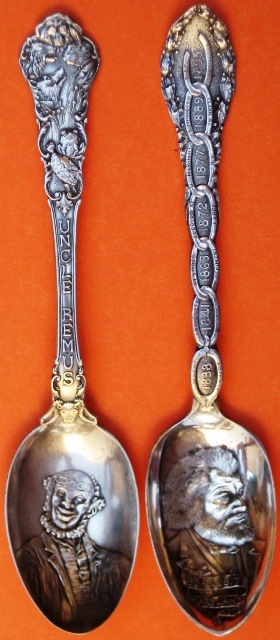

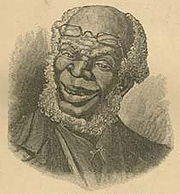
Uncle Remus comes from a collection of stories and oral folklore of the South which was published in 1881 and authored by Joel Chandler Harris. Mr. Harris was a reconstruction era journalist who states that this is his attempt to preserve the oral stories of the slaves of the South. Uncle Remus is a fictional old slave who is the narrator and who speaks in a heavy southern accent. At the time these stories were published they were not considered to be racist, however succeeding generations have had a very different interpretation. The picture is from the 1881 book and as you can see the spoon pretty accurately depicts Uncle Remus. The most famous of these stories is Br'er Rabbit and Br'er Fox, wherein the clever rabbit pleads with the fox to do anything except throw him into the briar patch, which is of course what the fox finally does. Succeeding generations have used this story to paint unflattering pictures of southern black folk and the derisive term 'tar baby' is derived from this story.
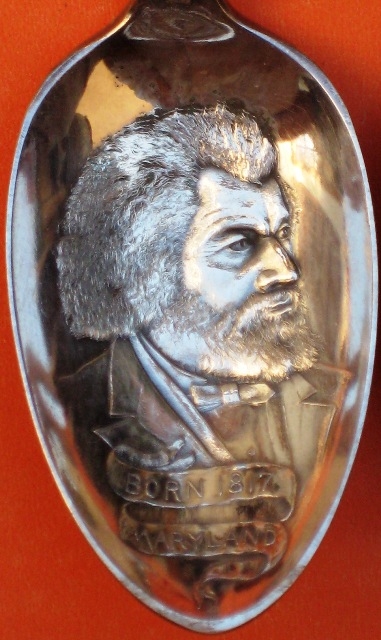
Frederick Douglass was born a slave in 1817, but he later became one of the most prominent figures in Black history in the USA. After escaping from slavery, he became famous as an author and orator and was a very strong believer in the equality of all people.
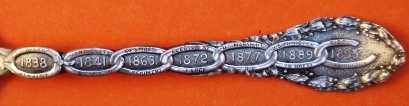
The spoon is a brief time line of his life. In 1838 he escapes slavery by pretending to be a sailor, gets married, and moves to Massachusetts where he changes his name from Johnson to Douglass. In 1841 he begins his new career as an anti-slavery orator. In 1863, Lincoln signs the Emancipation Proclamation and later welcomes Douglass into the White House. In 1872, Douglass is nominated to be Vice President of the US on the Equal Rights Party ticket. In 1877, President Hayes appoints Douglass to serve as a U.S. marshal for the District of Columbia. In 1889, Douglass is appointed to serve as U.S. minister resident and counsel general of the Republic of Haiti. In 1895, Douglass dies of heart failure.
This spoon could also be classified as a 'funeral' spoon in that it was produced as a commemoration of his life.
A variation of this spoon depicts the timeline on the back of the handle.
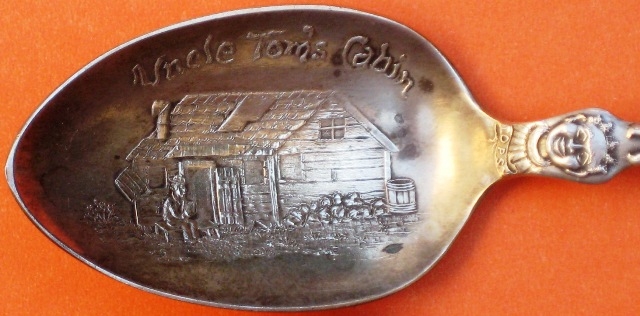
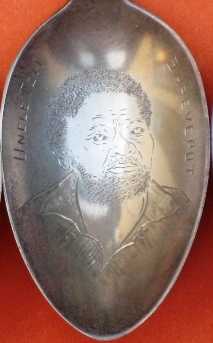
The best selling book in the 19th century (except for the Bible) was Uncle Tom's Cabin by Harriet Beecher Stowe.
This anti-slavery book published in 1852 had a profound impact on the opinions of Americans regarding the slavery issue. It is credited with fueling the abolitionist cause and it may have been one of the primary impetuses leading to the Civil War.
Upon meeting Stowe, Lincoln is credited with this remark:
"So this is the little lady who made this big war."
The novel focuses on the character of Uncle Tom, a long-suffering black slave, around whom the stories of other characters—both fellow slaves and slave owners—revolve. The story depicts the reality of slavery while also asserting that love can overcome something as destructive as enslavement of fellow human beings.
Return to Black Spoon Index
Return to Spoon exhibits index