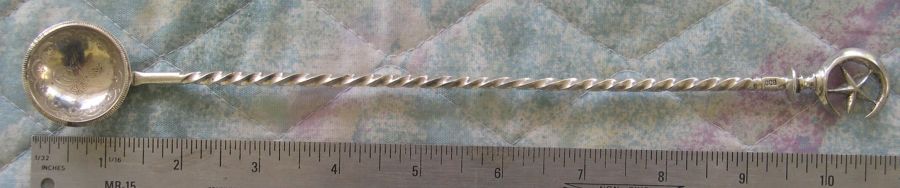
This large stirrer measures almost 11 inches
Mr. W. Kundis has explained to me that
"This long handled coin spoon is from the reign of the Ottoman Sultan Abdul Hamid II. His reign was from 31 Aug 1876 - 27 Apr 1909."
"Every Sultan had his personal Tughra or Arabic calligraphic signature which was stamped on anything of value produced during his reign."
The crescent moon and star are an ancient Turkish symbol of power which appears to have originated in Central Asia well over a thousand years ago.
The symbol was pre Islamic. However this symbol has recently been appropriated by the parts of the Islamic community and is now found on several modern nation flags
At the time this spoon was made, the symbol was only identified with Turkey


"Translating that (date) correctly is not easy even for Turks.
With the vast size of the Sultan's empire three calendars are used; Islamic lunar, Gregorian, and the Rumi calendar. Ottomans wrote in Turkish and also used the Arabic alphabet to write in Turkish."
The bowl is made from a 10 Kurush coin (only minted for two years and only 9000 were made)
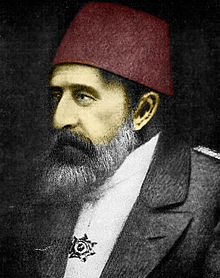
Abdul Hamid II
"During his tenure, he was responsible for both modernisation of the Ottoman Empire, as well as exerting maximum control over its affairs. Changes included: rationalisation of the bureaucracy; the ambitious Hijaz Railway project; the creation of a modern system of personnel records (1896); establishment of an elaborate system for population registration and control over the press; systematization of officials salaries (1880); first modern law school (1898). ." Wikipedia

seal of Abdul Hamid lll

Turkish 5 Kurush silver coins are used to create the spoon bowls
issued between 1876 -1880 and weighing about 6 grams (about the size of a quarter)
usually about 80% silver
tughra of Abdul Hamid 11

Turkish 5 Kurush coin bowl
nice Turkish dagger near the top
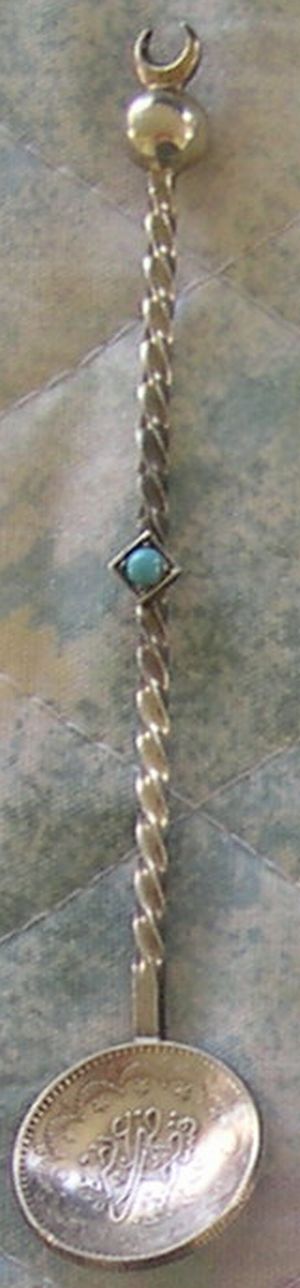
5 kurush silver coin bowl
this spoon also features a blue stone in the center of the handle
Return to Coin spoon exhibit index
Return to exhibits index