
Father Junipero Serra, a member of the Portola exploration team and a Franciscan friar, established the first California mission in the area now known as San Diego in 1769. The goal was to establish missions one day's walking distance apart. By the year 1823, the Franciscans had built 21 missions (they must have been very fast long-distance walkers).
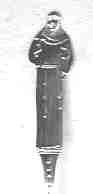
Father Junipero Serra
The purpose of the missions was to convert the "heathen" indians to Christianity and establish economic outposts in the new land. By the time of the Souvenir Spoon movement in the 1890's, most of the missions had been abandoned or fallen on "hard times". The preservationists began to restore some of the missions still in daily use and visitors would often visit the more popular and easily accessible missions. Note: some of the missions are still used today as churches.
The San Diego mission had significant deterioration, but since it was the first and since San Diego is such an ideal tourist destination, we do find spoons from this facility.
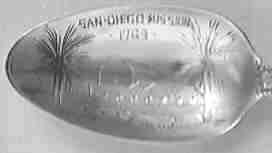
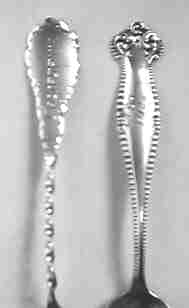
Engraved view of the ruins of the mission and example of two handles showing Mission scenes.
The first handle is a custom made spoon with nice bright cut design and a twisty lower piece.
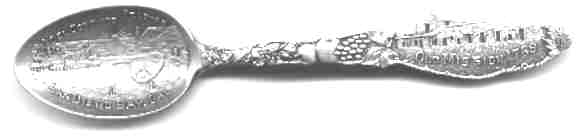
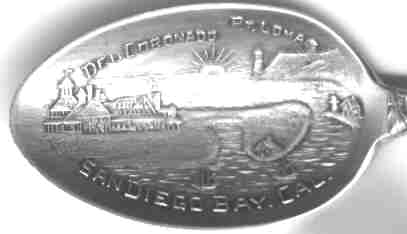
A nice souvenir spoon featuring a skyline view of the San Diego mission. The bowl has an unusual San Diego setting sun harbor scene.

Nice engraved spoon showing the San Diego mission and Ramona's wedding place

Embossed bowl from Carmel Mission established 1770

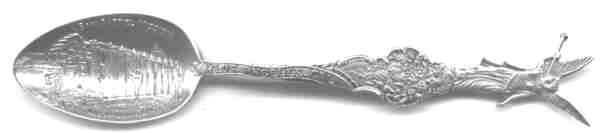
Angel blowing on a trumpet and San Gabriel mission in the bowl
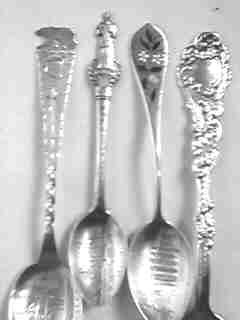

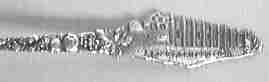
Because the San Gabriel mission (1771) is so close to Los Angeles, it received many visitors, consequently we find a number of spoons from this mission. The spoon with the bear finial refers to it as the "Los Angeles Mission". The third spoon from the left with the flowers is enameled, but the picture was converted to B&W
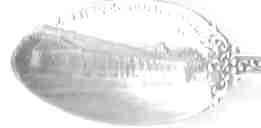
Engraved view San Luis Obispo de Tolosa (1772)
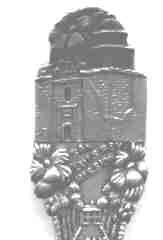
Also features the Mt. Lowe railway and a full figure palm tree on the back of the handle
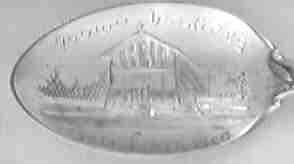
Mission Dolores (1776), San Francisco
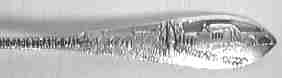
San Juan Capistrano(1776) where the "swallows" return every year
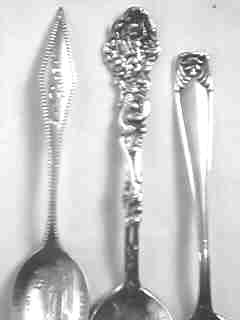
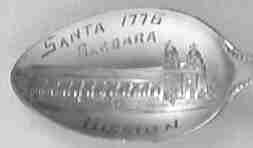
Santa Barbara (1786) is perhaps the best preserved of the missions. In addition, Santa Barbara about (150 miles north of Los Angeles) was a very popular tourist destination during this time period. With its ideal weather and beautiful beaches, it is not surprising that we find many spoons from this mission.
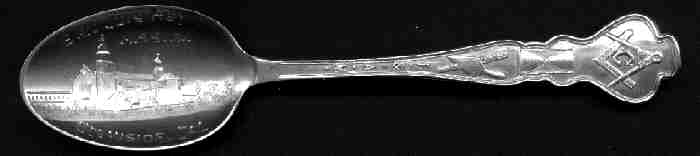
Engraved view of Mission San Luis Rey in Oceanside, California. The handle on this spoon contains Mason symbolism (unusual combination). I recently visited this mission and it has been completely restored.
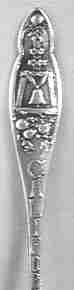
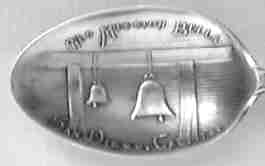
Manufacturers created generic spoons which could be sold at any of the mission sites. The mission bells were among the more popular of the images which identified the missions. In some cases the bowl would be engraved with the name of a mission and the generic handle would be used.
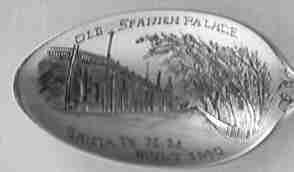
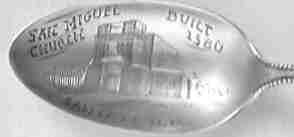
The Old Spanish Palace, Santa Fe, New Mexico San Miguel Church (1560)
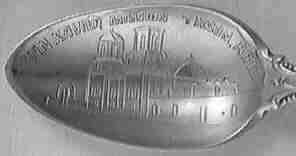
San Xavier mission; Tucson, Arizona
Return to Spoon World Index